The journeys and systems of this demonstrator, drawn as an ArchiMate overlay on the Reference Architecture (DPI-H)’s own ArchiMate model (smart-ra, version 0.3.0-draft.1). The RA’s elements are unchanged and keep their ids, so each RA box here is the element smart-ra publishes. The overlay adds:
- the journeys J1 to J4.1 (the use cases) as business processes, one per BPMN process;
- the people who take part, as business roles assigned to the journeys whose BPMN has their lane;
- each of those roles associated with the RA stakeholder it belongs to: the caregiver with Citizens / Care recipients, the clinicians and the community health worker with Health Workers (a role and a stakeholder are different element types, so ArchiMate allows an association, not a specialization);
- the systems of Taifafeki and Onesa, serving the journeys they take part in, each holding its parts, each part named by what it does (Patient record, Smart forms (SDC), Health workforce registry (CHWs, nurses)); the family’s shared phone is a technology device that realizes the wallet app on it, not software;
- for each country, its own instance of every RA building block its parts play, such as Provider Systems (Taifafeki) and Provider Systems (Onesa): Taifafeki and Onesa are different jurisdictions, so a part in Taifafeki realizes the instance of Taifafeki, as the RA draws a concrete system realizing the component it plays (its Table 3.3), and that instance is a specialization of the RA’s block;
- where the two countries meet, as flow and triggering relationships between their parts, read from the BPMN: the paper DVC that J1 prints and the family carries to J2 and J3; in J4.1, the VHL QR the family’s phone shows the Taifafeki clinic, the clinic’s signed ITI-YY5 manifest request to the Onesa gateway, and the manifest it returns, the access logged in Onesa;
- what they share, and nothing else, between them: WHO GDHCN and the WHO SMART Trust specifications it realizes;
- the RA’s own building blocks, generic and no country’s, in a band of their own below both countries in each journey’s view;
- each journey’s realization of the RA capabilities it exercises.
Every line is routed orthogonally through the gaps between boxes and never through a box, and ends on a side of its box clear of the box’s type label.
Every element names its concept in the
glossary
(skosConcept), drawn from the same sources as the model, and every role and
system names the FHIR ActorDefinition it realizes (fhir-actor).
Every box in a drawing links to its element’s page. All views and elements.
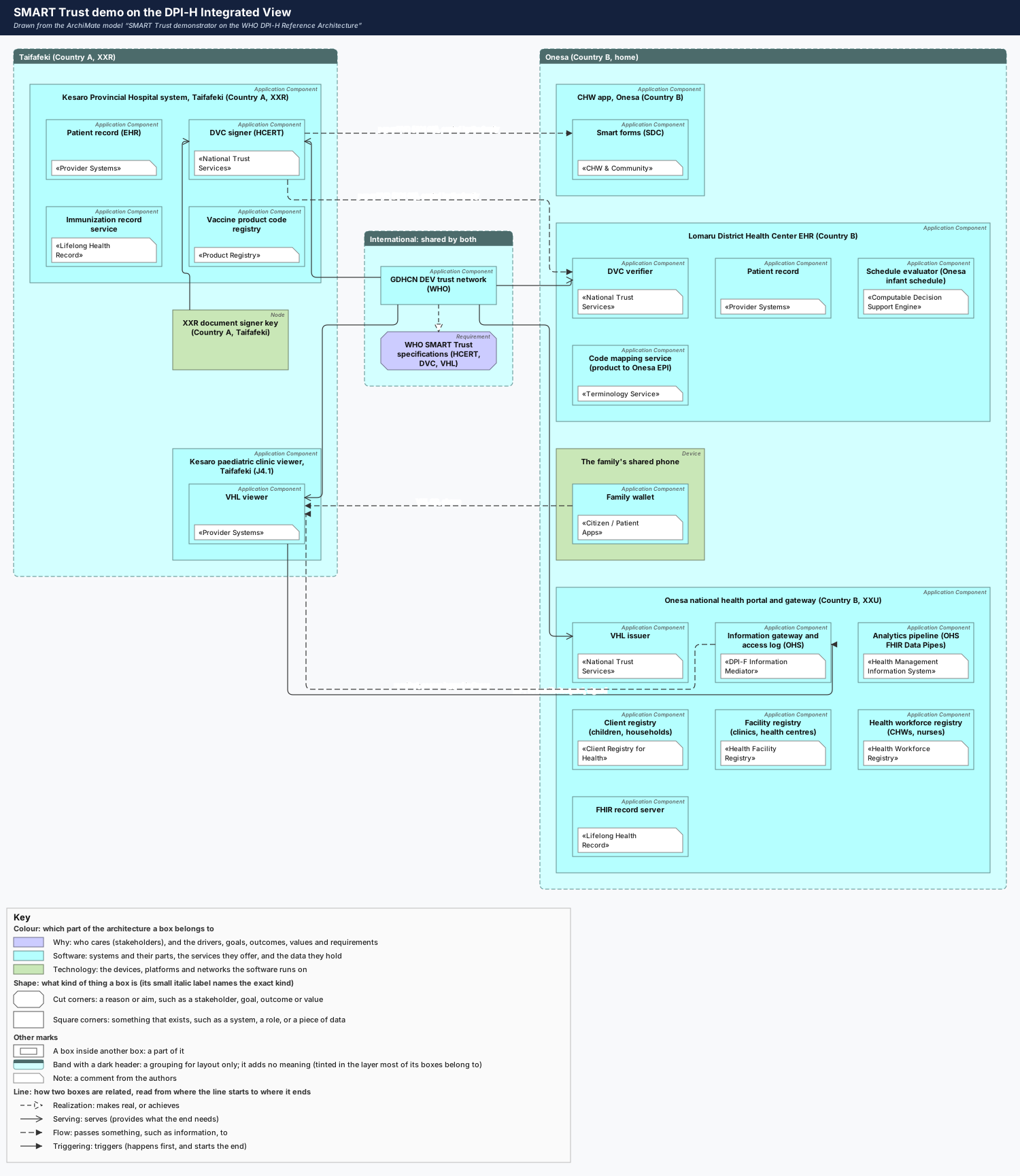
Systems on the Integrated View
Two columns: Taifafeki on the left, Onesa on the right. In each, the country’s systems stack top to bottom in the order of the first journey they serve, each holding its parts, and each part says inside its own box which DPI-H RA building block it plays, as a tag such as «Provider Systems». A system’s parts that meet the other country, or GDHCN, sit on the side facing the middle, and each Taifafeki system stands level with the first system of Onesa it meets, so the dashed lines where the countries meet run across. Between the columns, only what both share: WHO GDHCN and the SMART Trust specifications. The countries’ instances of the RA blocks, the parts’ realizations of them, and the RA’s own blocks are in the model and drawn in each journey’s view, which keeps this one narrow and its lines few.
Journeys (use cases)
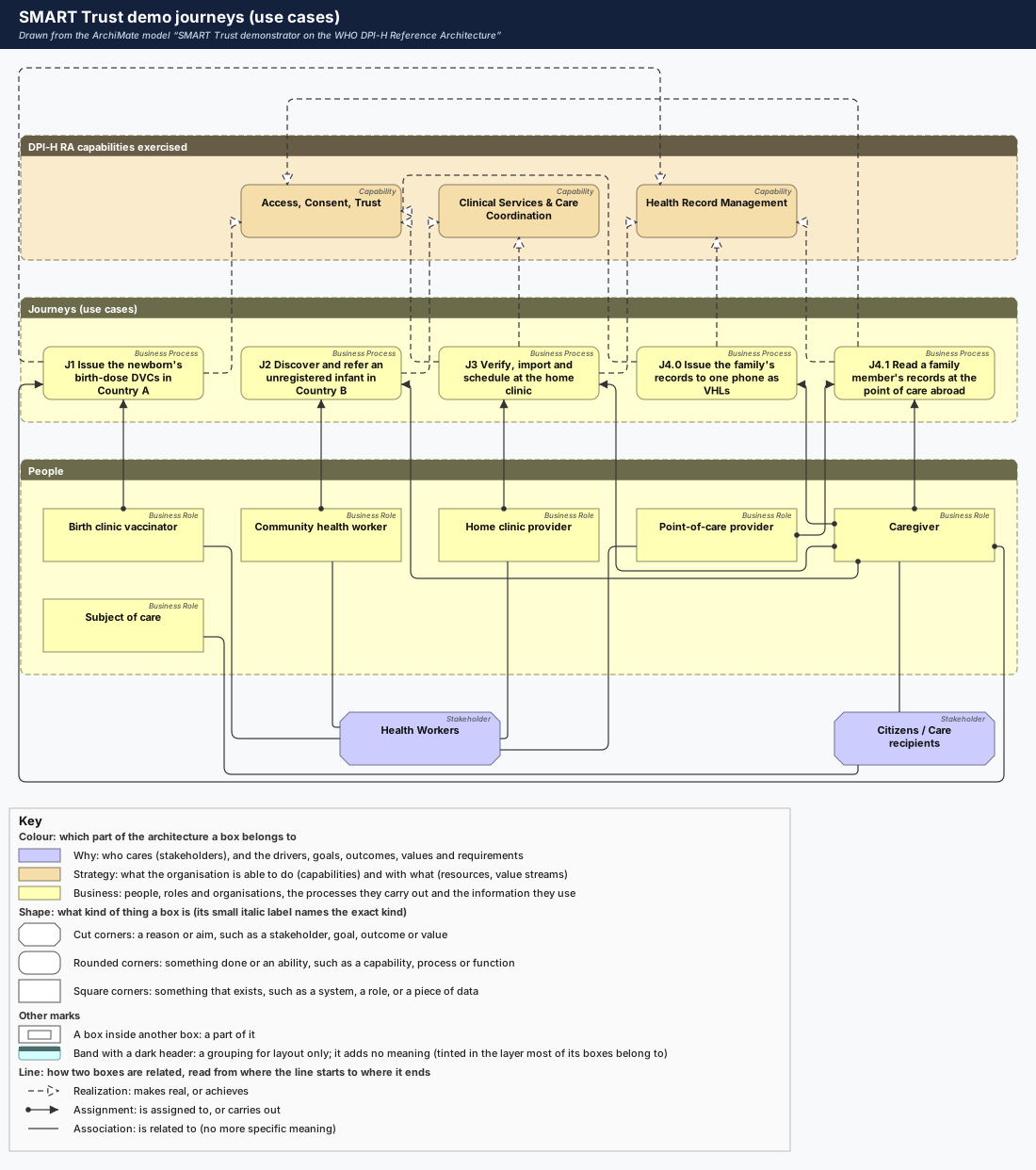
One view per journey
| Journey | View |
|---|---|
| J1 Issue the birth-dose DVCs | J1 on the DPI-H RA |
| J2 Discover and refer the infant | J2 on the DPI-H RA |
| J3 Verify, import and schedule | J3 on the DPI-H RA |
| J4.0 Issue the family’s VHLs | J4.0 on the DPI-H RA |
| J4.1 Read records at the point of care | J4.1 on the DPI-H RA |
How it is made
The model is generated, not drawn: python3 -I tools/archimate/build.py
fetches smart-ra’s model and its add_views.py at the commit in
tools/archimate/smart-ra.lock.json (sha256 checked), applies
tools/archimate/overlay.py, lays the overlay’s views out again with room
between the boxes and routes every line orthogonally as Archi bendpoints
(tools/archimate/layout.py), and writes archimate/0.1.0/smart-trust-demo.archimate.
The journeys and their people are read from processes/content/ and
scenarios/roles.json, and where the countries meet from the BPMN’s sequence
flows; the systems are the system actors of scenarios/actors/, and their
parts each actor’s meta.parts (first drawn as VaxLink’s architecture view).
tools/ig-gen/ig_gen.py writes the glossary from the same sources.
CI fails if the committed model is not what the build makes. The drawings are
cat-harness’s archimate subgraph’s: no Archi, no Java.