SMART Base, published by WHO. This guide is not an authorized publication; it is the continuous build for version 0.3.0 built by the FHIR (HL7® FHIR® Standard) CI Build. This version is based on the current content of https://github.com/WorldHealthOrganization/smart-base/tree/main and changes regularly. See the Directory of published versions
Built from commit 5891a220.
Home
| Official URL: http://smart.who.int/base/ImplementationGuide/smart.who.int.base | Version: 0.3.0 | |||
| Draft as of 2026-08-26 | Computable Name: Base | |||
Overview
WHO SMART Guidelines (Standards-based, Machine-readable, Adaptive, Requirements-based, and Testable) are a set of WHO clinical guidelines that have been transformed into a computable, interoperable format. They enable countries to rapidly adopt, adapt, and implement WHO recommendations within their digital health systems by providing structured, machine-readable clinical content.
A Digital Adaptation Kit (DAK) is the primary artefact of WHO SMART Guidelines. It is a structured, standardised package of clinical and operational content that represents a WHO health intervention in a computable form. Each DAK contains:
- Health interventions and recommendations – the clinical guidance from WHO
- Generic personas – representative end-users and actors in the health system
- User scenarios – narrative descriptions of how the guidance is used in practice
- Business processes and workflows – step-by-step care pathways
- Core data elements – the data dictionary for the health domain
- Decision-support logic – computable clinical decision rules
- Functional and non-functional requirements – system capability requirements
- Program indicators – aggregate measures and metrics for monitoring and evaluation
- Test scenarios – structured tests to validate conformance
The diagram below illustrates the nine components of a WHO DAK and how they relate to one another:

This implementation guide contains base conformance resources for use in all WHO SMART Guidelines implementation guides.
Authoring Lifecycle
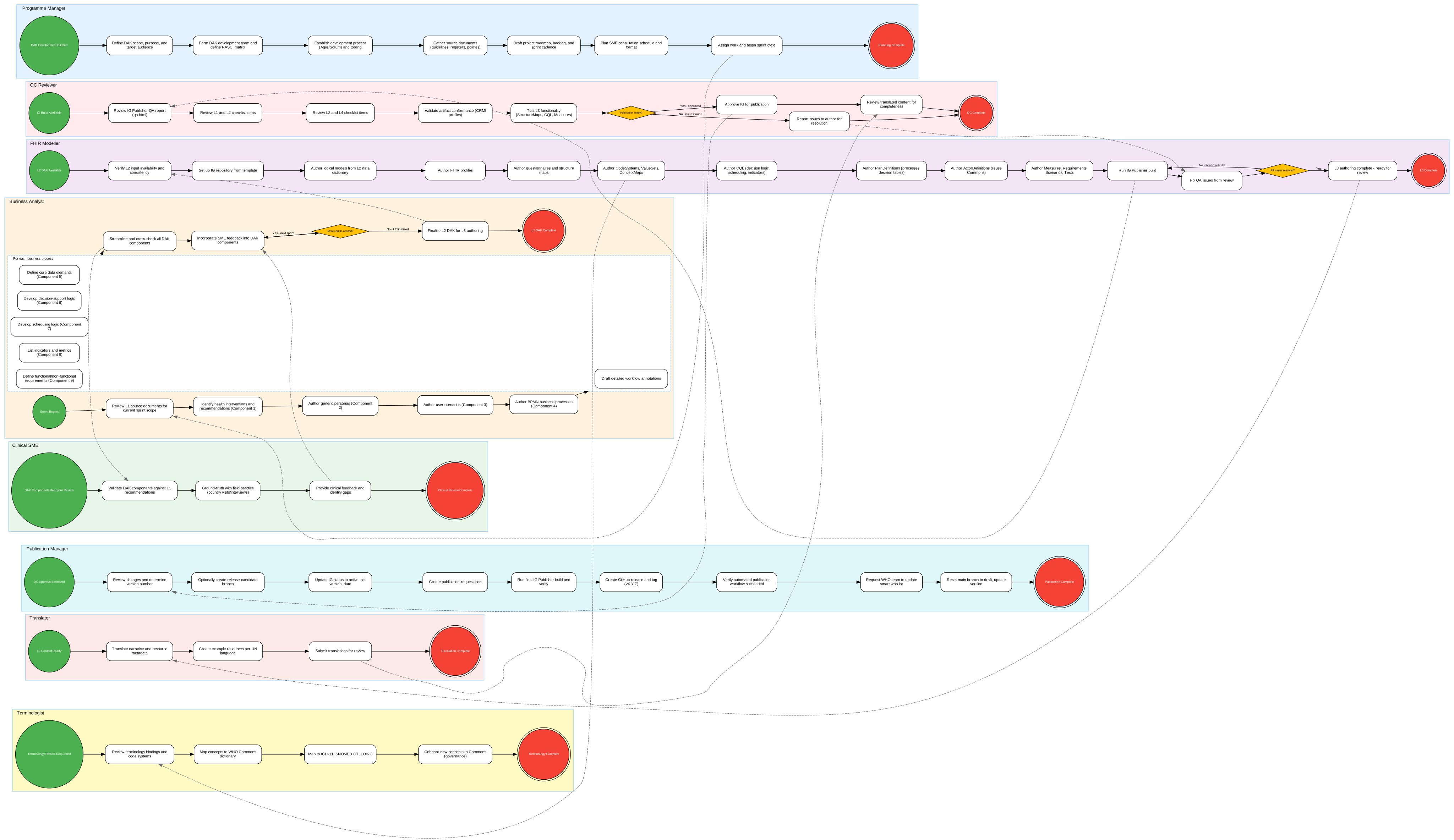
The DAK authoring lifecycle is a five-phase process spanning planning, L2 DAK authoring, L3 FHIR authoring, quality control, and publication. The BPMN 2.0 collaboration diagram below shows the end-to-end process with swimlanes for each authoring persona.
See the SMART IG Starter Kit for more information on building and using WHO SMART Guidelines.
DAK (Digital Adaptation Kit) URL Handling
For repositories that contain a dak.json file in the root directory, this implementation guide provides enhanced URL handling for publication and preview scenarios:
Publication URLs
- WHO Repositories: For repositories owned by
WorldHealthOrganization, the publication URL follows the patternhttps://smart.who.int/{stub}where{stub}is the repository name with anysmart-prefix removed. - Other Repositories: Use the canonical URL specified in
sushi-config.yamlor fall back to GitHub Pages pattern.
Preview URLs
- All Repositories: Preview URLs use the GitHub Pages pattern
https://{profile}.github.io/{repo}for current CI builds.
Branch-Based URL Selection
- Release Branches (prefixed with
release-): Use publication URLs for canonical references and resource identifiers. - Development Branches: Use preview URLs for canonical references and resource identifiers.
The DAK configuration is automatically regenerated during CI builds to ensure URLs are appropriate for the current branch context.
Dependencies
| IG | Package | FHIR | Comment |
|---|---|---|---|
  SMART Base SMART Base | smart.who.int.base#0.3.0 | R4 | |
 HL7 Terminology (THO) HL7 Terminology (THO) | hl7.terminology#7.3.0 | R5 | |
| FHIR Extensions Pack | hl7.fhir.uv.extensions.r4#5.3.0 | R4 | |
| Using CQL With FHIR | hl7.fhir.uv.cql#2.0.0 | R4 | This IG uses CQL profiles and capabilities provided by the Using CQL With FHIR IG |
| Clinical Practice Guidelines | hl7.fhir.uv.cpg#2.0.0 | R4 | For Decision Tables |
| Canonical Resource Management Infrastructure Implementation Guide | hl7.fhir.uv.crmi#2.0.0 | R4 | This IG uses content management profiles and capabilities provided by the Canonical Resource Management Infrastructure (CRMI) IG |
| Structured Data Capture | hl7.fhir.uv.sdc#4.0.0 | R4 | This IG uses questionnaire profiles and capabilities provided by the Structure Data Capture (SDC) IG |
  FHIR Tooling Extensions IG FHIR Tooling Extensions IG | hl7.fhir.uv.tools.r4#1.1.2 | R4 | for example references |
Cross Version Analysis
This is an R4 IG. None of the features it uses are changed in R4B, so it can be used as is with R4B systems. Packages for both R4 (smart.who.int.base.r4) and R4B (smart.who.int.base.r4b) are available.
Global Profiles
There are no Global profiles defined
IP Statements
This publication includes IP covered under the following statements.
- © International Labour Organization 2008Show Usage
- WHO © 2023. Some rights reserved. CC BY-NC-SA 3.0 IGO.Show Usage